

“Loneliness does not come from having no people about one, but from being unable to communicate the things that seem important to oneself.”
— Carl Jung (Renowned Swiss psychiatrist and psychoanalyst)
There’s a kind of loneliness that doesn’t look like loneliness from the outside.
The house is full. There are meals together, people coming and going, someone always talking. Nobody would describe you as isolated. And yet, at the end of the day, you have a quiet, heavy sense that no one really knows what’s going on inside you.
In my work with clients, this is one of the most common things people find hard to say out loud. They feel ungrateful even admitting it: “How can I be lonely? I’m never alone.” Attachment science offers a kinder and more accurate answer. Loneliness isn’t about how many people are around you. It’s about whether you feel seen and responded to by any of them.
Being Around People is Not the Same as Being Connected
The World Health Organization’s Commission on Social Connection reported in 2025 in their official news release that about 1 in 6 people worldwide is affected by loneliness, and linked loneliness to an estimated 871,000 deaths a year.
Those numbers aren’t just about people who live alone.
A detail from a large meta-analysis by Julianne Holt-Lunstad and colleagues published on PubMed makes the point well. Across 148 studies and more than 300,000 participants, stronger social relationships were linked to a 50% higher likelihood of survival.
But the type of measure mattered. The link was strongest for rich, complex measures of social integration and weakest for the simple question of whether someone lived alone or with others. In that comparison, the confidence interval crossed the line of no effect.
In other words, sharing a roof with people is not the protective part. The quality of the connection is.
What Attachment Theory Adds
Attachment research describes how we come to expect, from early on, whether the people close to us will be available and responsive when we need them. In a review of the last decade of research, Mario Mikulincer and Phillip Shaver describe how these expectations become fairly stable attachment orientations that shape how we feel and manage distress as adults.
Two patterns are especially relevant to the “lonely in a full house” experience:
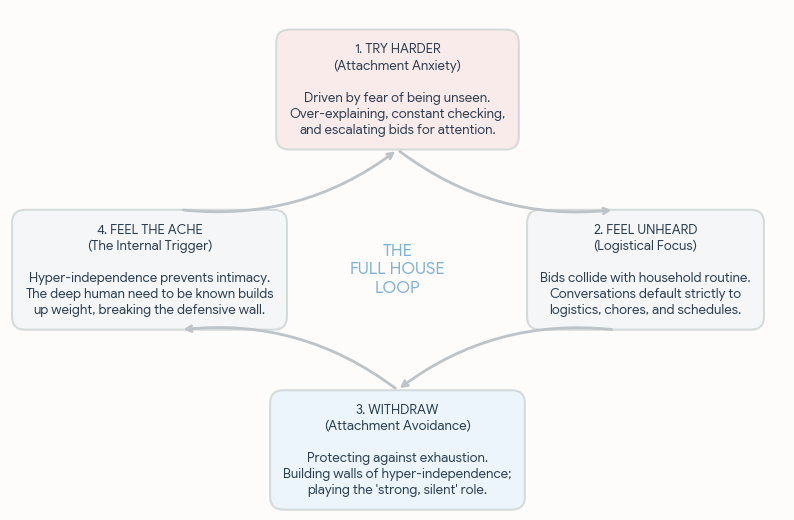
- Attachment anxiety. You reach for connection harder and harder. You might over-explain, check in repeatedly, or feel hurt by small signs of distraction. Underneath is the fear that if you don’t push, you won’t be noticed at all.
- Attachment avoidance. You stop reaching. You become the self-sufficient one, the capable one, the person who “doesn’t need anything”. It feels safer, but it also guarantees that no one gets close enough to really see you.
Many people in busy families move between the two. They try, feel unheard, withdraw, then feel the ache and try again.
How Families End Up Full but Unresponsive
Close families often run on roles. There’s the provider, the peacekeeper, the responsible eldest child, the one who looks after the parents, the strong one who never complains. Roles keep a household working. But a role is something people respond to; it isn’t the whole of you.
When conversation is mostly logistic (who’s picking up whom, what needs buying, who’s upset with whom), you can spend years in constant contact without anyone asking, “How are you, really?” and waiting for the answer.
Research on listening and perceived responsiveness helps explain why this kind of loneliness hurts so much. Guy Itzchakov and Harry Reis in their study on PubMed describe how being listened to, and sensing that the other person has genuinely taken in what you said, evokes a sense of interpersonal connection.
It’s not the amount of contact. It’s the felt sense that your inner world has landed somewhere.
Felt Security: Easing Loneliness in Small Moments
The encouraging part is that responsiveness doesn’t require grand gestures or a family meeting about everyone’s feelings. Brooke Feeney and Nancy Collins, in their model of thriving through relationships, describe close relationships supporting us in two ways: helping us cope when life is hard, and encouraging us to grow and take on new things. Both happen through ordinary interactions repeated over time.
A few practical places to start:
- Create one-to-one time. In a full house, almost every interaction is group interaction. Ten minutes alone with one person, whether that’s a short walk, a drive or tea after everyone else has gone to bed, changes what can be said.
- Make a specific, small bid. Instead of waiting to be asked, offer one honest sentence: “Work has been heavier than I’ve let on.” Then pause. You’re giving someone the chance to respond rather than testing whether they’ll notice.
- Ask for the kind of response you need. People often respond with advice when you wanted company, or with reassurance when you wanted to be understood. It’s fair to say, “I don’t need you to fix it. I just want you to know.”
- Notice your own strategy. If you lean anxious, practise one bid and then letting it rest, instead of escalating. If you lean avoidant, practise sharing one thing slightly before you feel ready. Both are small experiments in a new kind of safety.
- Offer what you’re missing. Responsiveness tends to spread. When you ask a sibling or parent a real question and actually listen to the answer, you often make it more likely that someone will do the same for you.
- Find at least one secure base outside the house. A friend, a community, a mentor or a therapist. Families can’t meet every need, and expecting them to adds pressure. Having one place where you feel fully seen often makes home feel lighter too.
Try This Today
Choose one person in your household. Sometime today, find five minutes alone with them and share one true sentence about how you’re doing, something a little more honest than “fine”. Don’t explain it or make it bigger. Notice what happens, in them and in you.
Connection in a full house isn’t built by spending more time together. It’s built by being a little more seen in the time you already have. And as you practice showing up more openly to ease loneliness in your relationships with others, pairing those small relational steps with daily mantras for calm and inner joy can help keep your own inner world grounded.
When Loneliness Becomes More Serious
Feeling unseen at times is part of family life, and it is okay to admit when the quiet ache feels heavy. While small daily shifts can gently bridge the gap, some seasons of isolation or loneliness carry a weight you shouldn’t have to lift on your own.
If your loneliness comes with persistent low mood, loss of interest, poor sleep, or thoughts that others would be better off without you, please speak to a mental health professional or a local or international helplines and joint-family support resources. Reaching out for help is an act of courage, not failure. Those are signs you deserve real, compassionate support —not something to push through quietly.