

Editor’s Note: Most of us promise ourselves we will remember an important life lesson, only to fall back into the exact same assumption weeks later. In this thoughtful guest essay, independent author Paul Michael Durivage explores why it matters to make a place for your corrections so fleeting insights turn into steady, practical judgment. Grab a quiet moment and see how a few honest lines on paper can gently reshape the choices you make next.
There is a particular kind of note that can be worth keeping: “I thought this would work. Here is what happened instead.”
It has none of the shine of a quotation chosen to inspire us. It may describe a plan that failed, an assumption that proved unfair, or an explanation we had to replace. Yet a collection of these small corrections can become a useful record of how we are learning to live.
People keep records of appointments, purchases and finished work. We often give less care to recording the changes in judgment that make future choices possible. An insight arrives, feels important, and disappears into the general intention to do better. Later, the same situation returns and the old assumption is available again, apparently undisturbed.
A correction note gives the new judgment somewhere to stay. It also allows us to look at it when the feeling that accompanied it has passed.
Keep the Situation Small Enough to Describe
Imagine that you agreed to finish a household project over a weekend. You counted the time needed for the main task and overlooked finding the materials, clearing the space and putting everything away. On Sunday evening, the work is unfinished and the room is less usable than it was on Friday.
“I am terrible at finishing things” is a large conclusion drawn from a particular planning mistake. It gives you an identity to carry but little help with the next estimate. A more useful note might read: “I allowed time for the central task and forgot the work around it. Next time, I will list preparation and cleanup before choosing a finish date.”
The imagined example is ordinary on purpose. A correction does not have to come from a dramatic failure. It can begin with a small inconvenience that has happened often enough to deserve attention. The question is which assumption could be described clearly and tested in a future situation.
Write What Changed
A short entry can contain four things: the earlier expectation, what you observed, the conclusion you now draw, and one change you want to try.
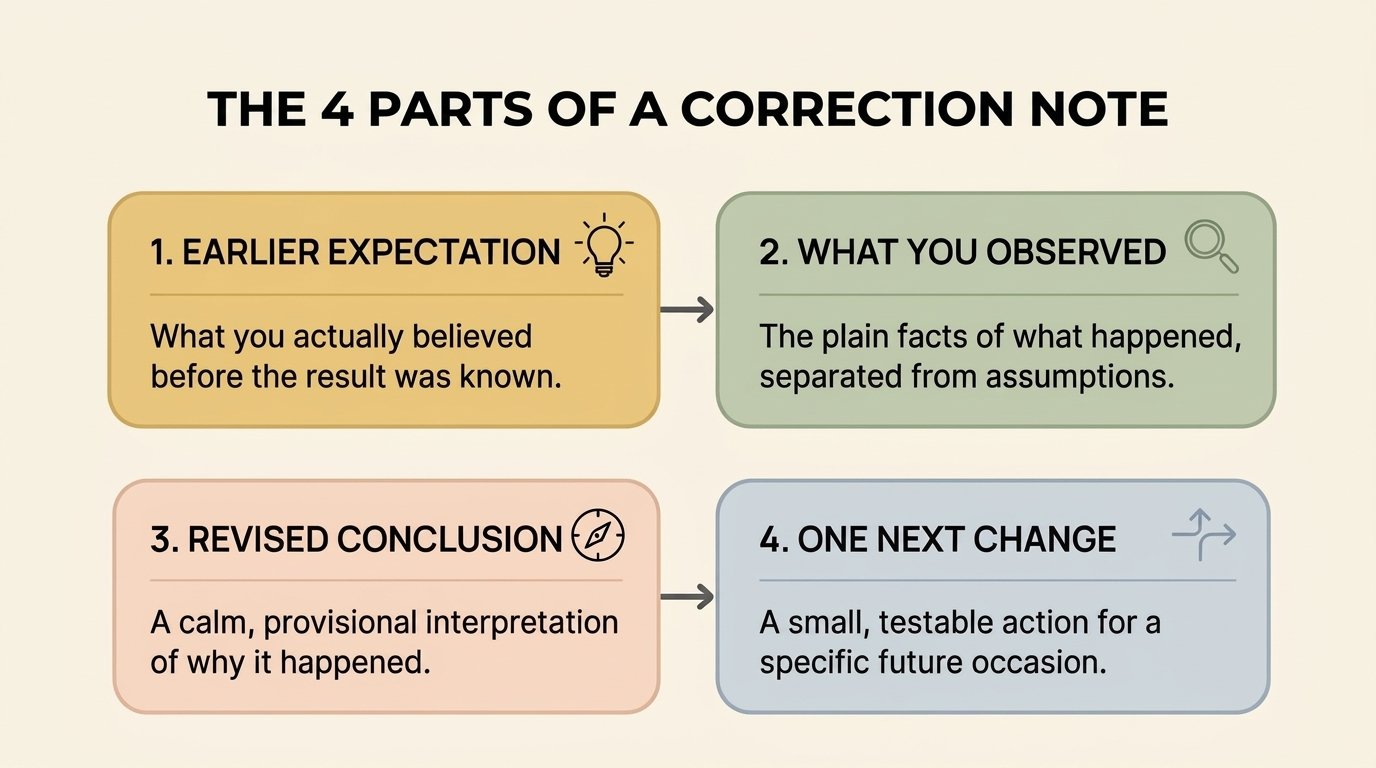
Each part does a different job. The expectation records what you actually believed before the result was known. The observation keeps the entry connected to something that happened. The conclusion offers an interpretation. The proposed change turns that interpretation into a decision you may be able to examine later.
Keeping those parts separate matters. Suppose a friend does not answer a message. “They do not care about me” is an interpretation. “I sent a message on Tuesday and had no reply by Thursday” describes an observation. There may be reasons to take a pattern of silence seriously, but the gap between the two statements is still worth seeing.
The correction may concern the interpretation itself. You might decide to ask a direct question before treating a delay as a final answer. You might also decide that a repeated pattern needs a conversation. The note does not have to settle the relationship. It can make your next action less dependent on an assumption you have not checked.
Let a Conclusion Remain Provisional
A correction can become another rigid rule if we give it more authority than the experience supports.
One unsuccessful collaboration does not establish that working with others is a mistake. One pleasant conversation does not establish that a difficult relationship has changed. An entry can be honest about its limits: “This happened once,” “I do not know the other person’s reason,” or “This approach helped with this particular task.”
Those qualifications leave room for future information. They also make the record more useful. A note that preserves the conditions of a lesson can help you recognize when the lesson applies and when a new situation needs a fresh decision.
Sometimes the next correction will be that you drew the first conclusion too quickly. That is an appropriate addition to a learning record. There is no need to erase the earlier entry so that the pages make you look consistently wise.
Give the Note a Future Occasion
An instruction such as “be more thoughtful” can apply almost everywhere and therefore guide very little. Try connecting the change to an occasion you can recognize.
Before agreeing to a deadline, list the preparation. Before forwarding an upsetting claim, open the source. Before offering advice, ask whether advice is wanted. These are ordinary examples, not a program everyone must follow. The useful action will depend on the mistake you are trying to understand.
Choose a change small enough that you can tell whether you attempted it. You can then revisit the entry after a relevant situation. Did the change help? Did it create a different difficulty? Did you discover that the original explanation was incomplete?
This review keeps the notebook from becoming a collection of resolutions that have never met another day. A lesson begins to earn confidence when it survives use, adjustment and another honest look.
Keep Other People’s Lives Out of the Permanent Record
If a correction involves someone else, record only what you need to understand your own choice. Their private history is not necessary to prove that you learned something. Initials, an unnamed role or a general description may be enough. Some details are better left unwritten.
The note can also acknowledge your share without claiming responsibility for everything. “I should have asked what the request meant” is different from deciding that another person’s conduct was caused by your failure to ask. Learning requires proportion as well as honesty.
Make the Record Easy to Return To
A few lines in an existing notebook may be enough. A plain document can work too. There is no need to create an elaborate system before recording the first useful correction. Give the entry a date and a title that will mean something later.
Over time, the record may show repeated themes. You may promise too quickly when you want to please someone, or treat preparation as though it takes no time. Seeing a pattern gives you a more specific place to practice. It can also reveal changes you might otherwise overlook: an estimate that became more realistic, a question you began asking, an unnecessary argument you learned to leave alone.
The pages will contain things you once misunderstood. That is what makes them worth keeping. Opened honestly, they offer a modest form of evidence that your next judgment does not have to be the same as your last one.
Key Takeaways: How to Make a Place for Your Corrections
- Capture insights before they fade. When you make a place for your corrections, daily self-reflection keeps new lessons visible—and choosing to make a place for your corrections early stops old habits from returning undisturbed.
- Separate facts from stories. Taking time to make a place for your corrections helps you record what actually happened rather than what you assumed, so you can make a place for your corrections with honesty and calm.
- Keep every lesson open to growth. A humble record lets you make a place for your corrections without rigid rules—so every time you make a place for your corrections, your future judgment grows wiser.